
Pothos in Low Light: What Actually Happens
A pothos in low light will not die. It slowly stops looking like a pothos, and how fast depends entirely on which cultivar you happened to buy.
Pothos in Low Light: What Actually Happens
A pothos in a dark room does not die. It slowly stops looking like a pothos, which is a different problem and takes long enough that most people do not connect the two.
How fast that happens depends on something the low light lists never mention: which pothos you have. The variegated cultivars and the plain green ones have genuinely different light requirements, and that single fact explains why the published advice about this plant contradicts itself.
The short version
- It survives dim conditions. That part of its reputation is earned.
- Variegation is the first thing to go, because the pale parts of a leaf cannot photosynthesize.
- Snow Queen and Marble Queen need the most light. They are mostly white.
- Neon and Jessenia tolerate the least light. They are mostly green.
- Leaves that have already gone plain stay plain. Judge recovery by new growth.
Why the sources disagree about pothos
If you have read around on this, you will have found pothos filed under low light in one place and medium light in another. Both were right, about different plants.
Clemson Cooperative Extension states the general position and its caveat in the same breath: Pothos prefer bright, indirect light but will tolerate lower lighting conditions. Then it adds what that tolerance costs: However, lower light may cause variegated varieties to lose some of their coloring.
University of Wisconsin Horticulture reaches the same place from the other direction, noting that the plant will survive a wide range of environmental conditions while stating plainly that Low light can result in loss of variegation.
Prefers bright. Tolerates dim. Loses its markings in the process. Whether you call that a low light plant depends on whether you count the markings as part of the plant, which is exactly the survives-versus-grows distinction covered in what a north-facing window actually gives.
Which pothos you have matters more than the room
Clemson's cultivar notes are the most useful thing on this subject and almost nobody quotes them.
Snow Queen, which is predominantly white with green speckling, Needs lots of bright, indirect light to ensure adequate growth. Marble Queen pothos light requirements run higher still: with its white and cream variegation, Clemson notes it requires more light than other varieties. At the other end, Neon is described as a hardy pothos that tolerates lower light conditions, and Jessenia Tolerates lower light conditions than 'Snow Queen' and 'Marble Queen'.
Line them up and the pattern is a clean dose relationship:
| Cultivar | Foliage | Light demand |
|---|---|---|
| Snow Queen | Predominantly white, speckled green | Highest |
| Marble Queen | Striking white or cream variegation | High |
| Pearls and Jade | Green speckled, large white spots | High |
| Golden Pothos | Green with yellow marbling | Moderate |
| Jessenia | Dark green with green and yellow variegation | Lower |
| Neon | Solid lime green | Lowest |
One note on that table. Clemson assigns a light demand explicitly for Snow Queen, Marble Queen, Pearls and Jade, Jessenia and Neon. Golden Pothos is placed where the same logic puts it rather than where Clemson places it, because that page does not give it a level. Treat that one row as an inference from the pattern and the rest as sourced.
The more white on the leaf, the more light the plant needs. That is not a coincidence or a quirk of breeding. The pale sections contain little or no chlorophyll, so a heavily variegated plant is running the same operation with a fraction of the equipment. Buying a Snow Queen for a dim corner is buying a plant that has voluntarily given up half its capacity and then asking it to work in the dark.
Wisconsin notes that the 'Jade' cultivar, which is solid green, does well in low light areas. Same species, opposite advice, and the leaf tells you which one applies.
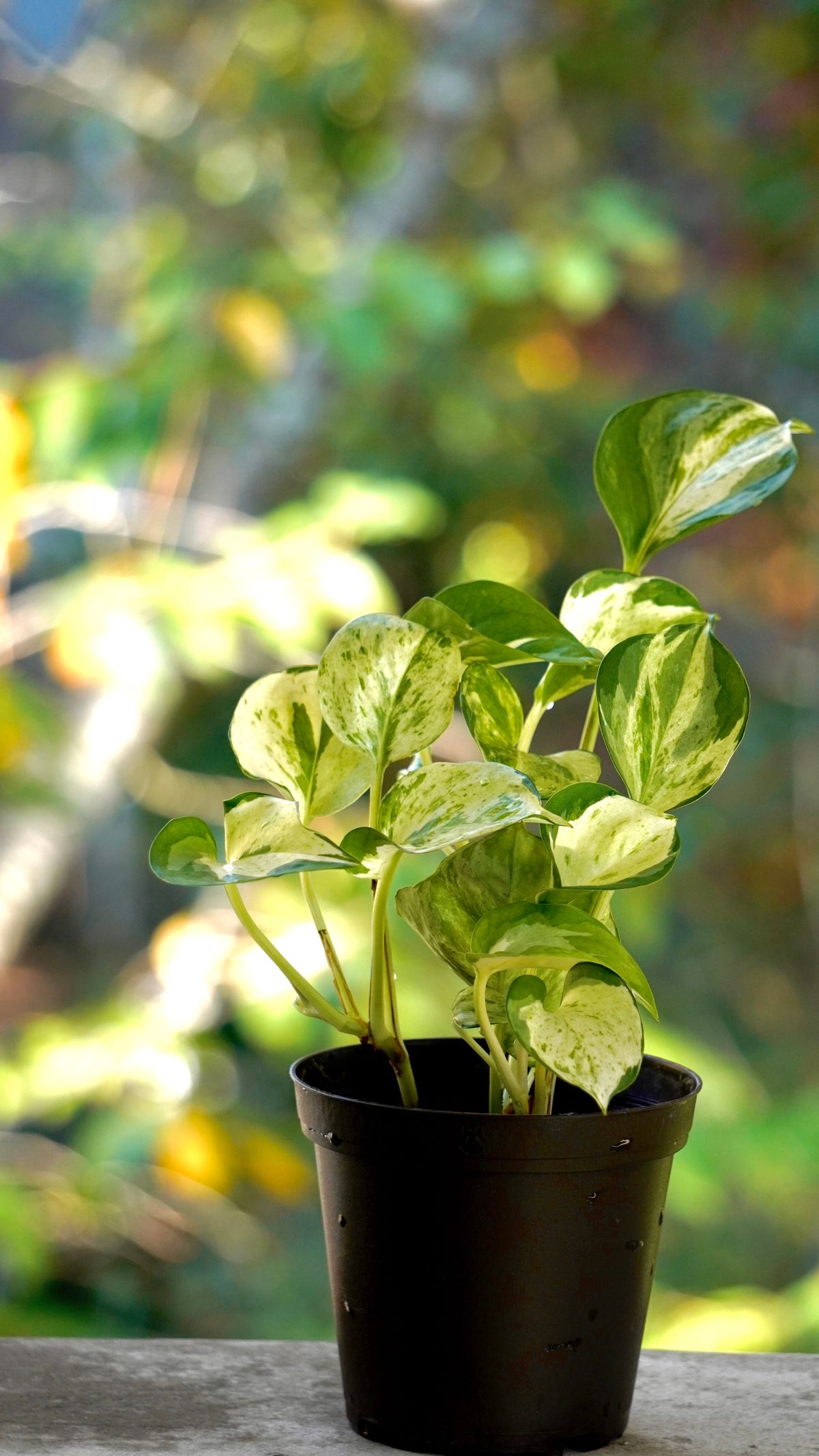
What a pothos does in low light
Three things happen, in this order, and none of them is dramatic enough to trigger action on its own.
The variegation fades or disappears. Both sources say so directly. New leaves come in greener than the old ones, because green is what the plant can afford. People read this as the plant recovering, since green looks healthy. It is the plant economizing.
The leaves come in smaller. Wisconsin notes that The leaves of pothos grow much bigger as they mature, and that maturation is exactly what stalls in poor light. A vine that produces small leaves indefinitely is not young, it is underfunded.
The gaps between leaves get longer. The stem stretches toward whatever light exists, so you end up with more vine and less plant per foot. Straggly growth is what people notice first, usually described as the plant getting straggly.
None of it kills anything. A pothos will carry on in that state for years, which is precisely why it earned its reputation and why that reputation is half true.
Watering a pothos in low light
The dimmer the spot, the slower the pot dries, and pothos is specifically vulnerable to what follows.
Clemson's instruction is unusually firm for this plant: Allow the soil to dry completely before watering. Wisconsin's is similar, advising a well-aerated medium and watering only when the soil surface is dry.
Now combine that with a low light position, where evaporation is slow and the plant is transpiring less because it is doing less. The same watering habit that suited a bright windowsill becomes overwatering without anything about the schedule changing. An unchanged watering habit is the most common way a healthy low light pothos becomes a sick one, and it is covered properly in overwatering vs underwatering.
If you want to know what your spot actually provides before adjusting anything, the light estimator gives a foot-candle range from six questions about your window.
Black tips and edges
Worth knowing because it is easy to misread as a light problem.
Wisconsin lists three causes at once: Blackening of the leaf margins or tips can be caused by overwatering, inadequate watering, or excess fertilizer.
Note that light is not on that list. If your pothos has dark, dead tips, the answer is in the pot rather than the window, and brown tips on houseplant leaves sorts out which of those three you are looking at, starting with the one that leaves visible evidence.
If yours has already gone plain
The faded leaves are not coming back. Variegation is set when a leaf forms, and no change in conditions restores it to a leaf that is already open.
What can change is what comes next. Move the plant closer to the glass, or add light, and the new growth will reflect the new conditions. That is the honest measure of whether anything you did worked: not the old leaves greening up, but the next few leaves arriving with more pattern and less stem between them.
If moving it is not an option and you like the plant as it is, there is nothing wrong with a green pothos. It is a perfectly good plant. It is just no longer the plant you paid extra for.
One thing worth settling before any of this applies: pothos and heartleaf philodendron are sold in the same hanging pots and look alike, and the leaf stalk separates them in a second. That check, and a key to the other common houseplants, is in identify a houseplant by its leaves.
And if you want the same position filled by something that will not visibly change at all, a snake plant in low light is the plant that does that. It fails in the opposite direction: it keeps its looks and loses its tolerance for being watered on schedule.
There is a third pattern worth knowing, because between them these three cover most of what a dim room does to a plant. A monstera in low light keeps producing new leaves at a normal rate, and every one of them arrives small and without holes. Nothing looks wrong, which is why it takes people years to notice.
Starting again from the good part
A vine that has gone plain and leggy is also the easiest plant in the apartment to replace with itself.
Iowa State lists pothos among the species that are very easy to propagate, and Illinois specifies the cutting: three to six inches, two to six nodes, two or three leaves left on. Take it from the section that still has the pattern you want, root it in a medium rather than the usual jar of water, and you have a compact plant from the same vine in about two weeks. The procedure and the reason to skip the jar are in how to propagate houseplants.
Common questions
Can pothos live without sunlight? It can live in low light for a long time, and both Clemson and Wisconsin describe it as tolerant of a wide range of conditions. What it cannot do is keep its variegation and its leaf size there. Living and thriving are separate outcomes for this species more than most.
Why is my pothos losing variegation? Almost always light. Clemson states that lower light may cause variegated varieties to lose some of their coloring, and Wisconsin says low light can result in loss of variegation. The pale parts of the leaf cannot photosynthesize, so in a shortage the plant produces greener leaves.
What is the best pothos for low light? The plainest one you like. Clemson describes Neon as a hardy pothos that tolerates lower light, and Jessenia as tolerating lower light than Snow Queen and Marble Queen. Wisconsin says the solid green 'Jade' does well in low light areas.
Why does my pothos have small leaves? Usually light. Wisconsin notes pothos leaves grow much bigger as they mature, and that maturing is what stalls in a dim position. Long gaps between small leaves is the same signal read a different way.
Do Marble Queen and Snow Queen need more light than other pothos? Yes, and Clemson says so specifically. Snow Queen needs lots of bright, indirect light for adequate growth, and Marble Queen requires more light than other varieties. They are the most heavily white cultivars, which is the reason.
One thing to check
Hold a new leaf next to one of the oldest leaves on the same vine.
If the new one has less pattern, smaller area, or a longer stretch of bare stem behind it, the plant is telling you about the light it is getting now versus the light it was getting when the old leaf formed. That comparison costs nothing and is more reliable than any general rule about what a pothos in low light can tolerate.