
How to Propagate Houseplants: The Jar of Water Is the Weak Method
How to propagate houseplants without the part everyone does. Illinois Extension advises against rooting in water, and the reason shows up weeks later.
How to Propagate Houseplants: The Jar of Water Is the Weak Method
How to propagate houseplants is, on most of the internet, one image: a cutting in a jam jar on a windowsill, roots visible through the glass. It works often enough to have become the default, and an extension service recommends against it in as many words.
The reason is not snobbery about method. Roots grown in water are built differently from roots grown in a solid medium, and the difference does not show up until you pot the cutting and it stalls.
The short version
- Illinois advises against water rooting. Water roots adapt poorly to potting mix.
- Two nodes minimum, six maximum, on a stem cutting of three to six inches.
- A week to two weeks is the normal rooting time indoors.
- Pot up at one inch of root. That is the published trigger, not a guess.
- Never propagate from a plant with pests, however good the cutting looks.
Can you propagate plants in water?
Yes. Illinois Extension's position is that you should not.
Illinois states it plainly, and names the plants people do it with: Although some plants such as ivy and philodendron will root easily in water, we do not recommend doing this. The mechanism follows immediately: Roots that develop in water are often weak and do not adapt as easily to potting mix as those that were formed in rooting media.
That explains a failure people usually blame on themselves. The jar goes well for weeks, the roots look abundant, the cutting is potted, and then it sits and sulks or collapses. Nothing went wrong at the moment of potting. The roots were the wrong kind of root the whole time, adapted to a medium with no particles to grip and abundant dissolved oxygen, and asked to work in one that is the opposite.
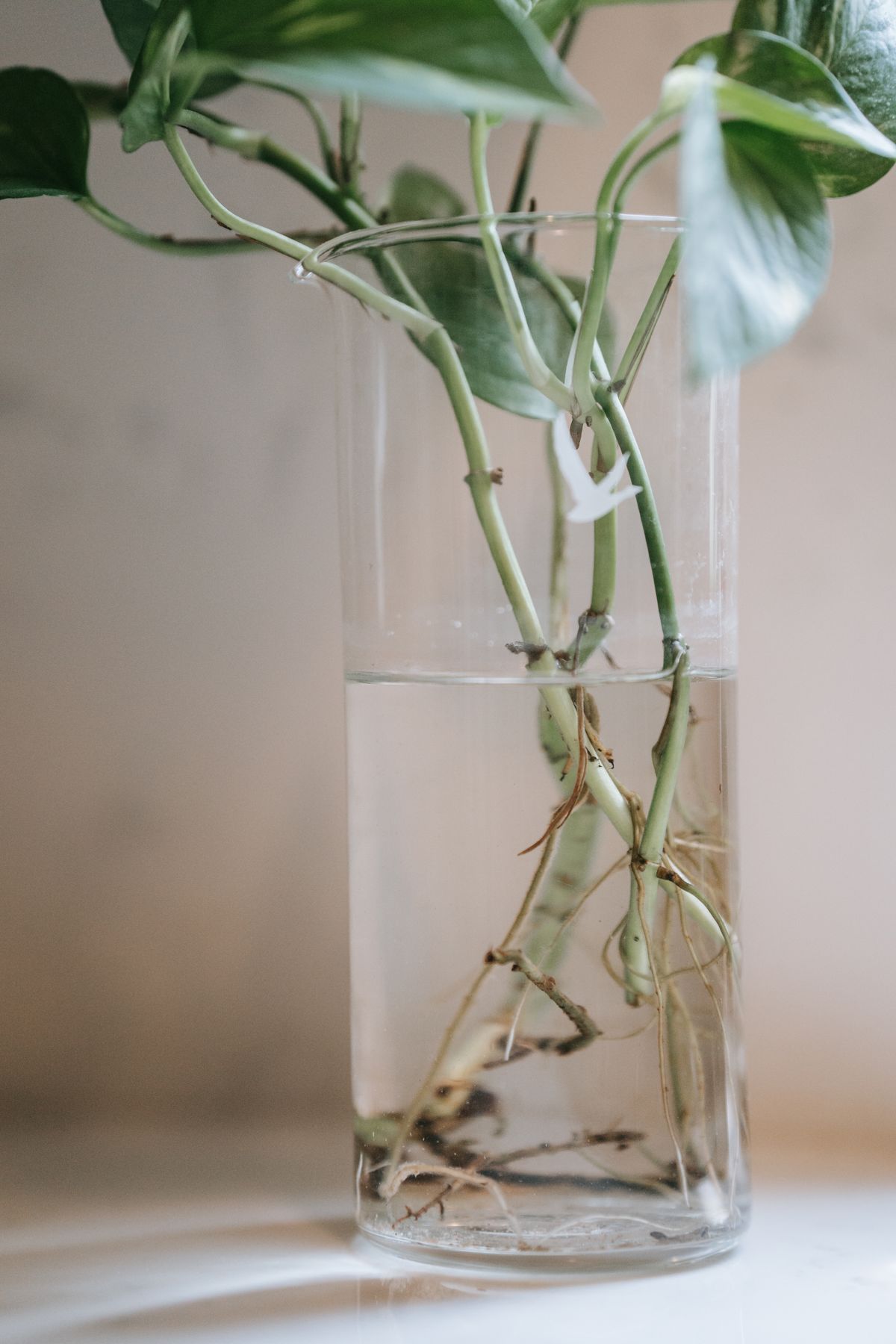
Two honest qualifications. Water rooting is not useless: it works, especially for pothos and philodendron, and a plant that establishes badly is not a plant that dies. And it is the only method that lets you watch, which is a real part of why people do it.
What Illinois recommends instead is a solid rooting medium, and their criterion for one is worth reading before buying anything: A suitable rooting media will provide support and enough water and oxygen to the root zone. Support and oxygen, which a glass of water supplies neither of. Their materials list is Coarse sand, peat moss, perlite vermiculite or a combination of these materials, and cleanliness is stressed: It is very important to begin with clean, disease-free media, which is a different property from the ordinary mix discussed in best soil for houseplants.
What is a node on a plant, and how big should a cutting be?
The node is where the new roots come from, which is why a cutting without one is a leaf in a jar. It is defined, in Illinois words, in the glossary.
Illinois defines it in passing while giving the specification for a stem cutting: In general, each stem cutting should have a minimum of two nodes, but not more than six. A node is where the leaf emerges. Sometimes it is a bumpy or raised area.
The rest of the specification, all in published numbers rather than feel:
- Length. Stem cuttings are usually 3-6 inches long.
- Which part. The tip of the stem is usually selected and often gives the fastest result, though mid or basal sections work for most plants.
- Leaves. Make a clean stem cut and remove excess leaves, allowing 2–3 to remain. Too many leaves means the cutting is transpiring water it has no roots to replace.
- Depth. Remove any leaves that would be below the soil line, and insert cuttings 1-3 inches deep.
- Flowers. If the stem is flowering, remove the flowers so that the energy can be devoted to producing roots.
Two procedural details that are easy to skip and worth not skipping. Tools should be sharp and sterilized: Illinois says they should be sterilized before and between each cut by dipping in denatured alcohol. Between each cut, not once at the start.
And humidity, which is the part a plastic bag solves for nothing: To keep humidity high, place a clear plastic bag over the pot and cutting(s). Move to bright light. Do not place in direct sunlight.
One exception with its own rule. Some plants must dry before they are planted. Illinois lists succulents, cacti, geranium (Pelargonium) and rubber plant (Ficus) as plants that should not be directly stuck into rooting media without first allowing the cut surface to air dry and heal over, because During this waiting period, callous tissue forms on the cut end and helps prevent disease. That is the step to observe when beheading a stretched succulent, which growing succulents indoors explains why you might be doing, and when taking a tip cutting from a rubber plant, whose sap is the reason it is on the list: rubber plant care mistakes covers what that sap does.
How long do cuttings take to root, and when to pot up a cutting
One to two weeks, and the signal to pot up is measured rather than judged.
Then the trigger, which is the most useful single number on this page: When roots are one inch long, it is time to plant the cuttings into their individual pots.
One inch. Not "when it looks like a lot of roots", which is the instinct and which is exactly what goes wrong in a jar, where people wait for a spectacular root mass and pot up something that has spent a month building the wrong tissue.
| Stage | Timing | What to look for |
|---|---|---|
| Cut taken | Day 0 | Two to six nodes, two or three leaves left |
| Soft-stemmed species root | About a week | Resistance to a gentle tug |
| Tougher stems root | 10 to 14 days | Same |
| Pot up | At one inch of root | Individual pots, ordinary mix |
| Established | Weeks after that | New leaf, not just new roots |
The pot they go into should be small. A rooted cutting in a large pot is the over-potting failure described in best pots for houseplants, applied to the plant least able to withstand it.
Do I need rooting hormone?
For most houseplants, no. For the difficult ones, yes.
Illinois describes what it does: rooting hormones are chemical substances that increase the rooting percentage of many plants, and one tends to shorten the time needed for rooting and often increases the quality and quantity of roots that form.
Then the part that saves you the purchase: Many houseplants root so easily on their own that rooting hormones are not important. For more difficult-to-root species, rooting hormones would be helpful.
If you do buy it, they note The powdered form is good because it is diluted with talc and ready for use.
How to propagate houseplants by division
The other main method, and the one that produces a full-sized plant immediately rather than a baby.
Illinois: Division will work for plants that grow in clumps or have more than one stem arising from the soil. The procedure is short: Simply remove the plant from the pot and pry apart the multiple stems so that each remaining stem has a fair amount of roots, then Re-pot each piece immediately, so that the roots do not dry out. Tough root balls may need a sharp knife.
Snake plants belong here rather than in the cuttings section, and Penn State also recommends dividing them rather than taking leaf cuttings, as covered in snake plant in low light. It also suits peace lilies, calatheas and most clumping plants.
Division is worth pairing with repotting since the plant is already out of its pot, and it is the natural moment to inspect the root ball for the white specks that mean mealybugs.
When not to propagate houseplants at all
Two conditions, both from Iowa State, and the first one overrides enthusiasm.
Not from an unhealthy plant. Their instruction is unqualified: Only propagate from healthy, vigorously growing plants. The exclusions they list are plants that have disease or insect pest problems, show signs of viruses (such as mottled leaves and weak growth), or do not have vigorous growth.
That matters more than it sounds in a small apartment. Taking a cutting from a plant with spider mites or scale creates a second infested plant and moves it to a new shelf, which is the opposite of isolating it.
Season is a preference rather than a rule. Iowa State: Most houseplants can be propagated any time of the year, but early spring through summer is the best time for the health of the propagules and the parent plant. Winter propagation is possible and slower, for the same light reasons as everything else in houseplant winter care.
One thing worth ruling out entirely: seed. Iowa State notes that since houseplants rarely flower indoors and lack pollination mechanisms there, sexual propagation through seeds is impractical.
The easy ones to start with
Iowa State publishes a list of species that are very easy and worth starting a propagation habit on. Among them: pothos, snake plant, spider plant, ZZ plant, Chinese money plant, tradescantia, arrowhead plant, jade, heartleaf philodendron, English ivy, aloe and African violet.
Three of those already have care pages here, and the method differs for each. Pothos and heartleaf philodendron are stem cuttings, snake plant is better divided, and jade and aloe are the callousing group that must dry before planting.
Common questions
Can you propagate plants in water? You can, but Illinois Extension advises against it, noting that roots developed in water are often weak and do not adapt as easily to potting mix as roots formed in a rooting medium. If you do it anyway, pot up early rather than waiting for a large root mass.
What is a node on a plant? The point where a leaf emerges from the stem, sometimes visible as a bump or raised area. Illinois specifies a minimum of two nodes and no more than six per stem cutting, because roots form there.
How long do cuttings take to root? Around a week for tender, water-filled stems and 10 to 14 days for tougher ones, according to Illinois. Check regularly rather than waiting for a set date.
When should I pot up a cutting? When the roots are one inch long, per Illinois. Waiting for a much larger root system, which is the temptation with a jar of water, makes the transition harder rather than easier.
Do I need rooting hormone for houseplants? Usually not. Illinois notes that many houseplants root so easily that rooting hormones are not important, and recommends them for more difficult-to-root species.
Can I take cuttings in winter? Yes, though Iowa State puts the best window at early spring through summer for the health of both the cutting and the parent plant. Expect slower rooting in a dim room.
How to propagate houseplants for free, starting this week
Sterilize the scissors before you cut anything.
That is the step people skip, it costs nothing, and Illinois asks for it between every cut rather than once. Everything else about how to propagate houseplants is forgiving: the wrong length still roots, the wrong month still roots, and a cutting that fails costs you a stem. A contaminated blade moving between plants is the one mistake that turns a free hobby into a problem on several shelves at once.