
Best Pots for Houseplants: Size First, Material Second
The best pots for houseplants are barely bigger than the plant already in them. Why size decides root rot, and what terracotta actually changes.
Best Pots for Houseplants: Size First, Material Second
The best pots for houseplants are the ones barely larger than the plant already in them. Size decides whether the roots rot; material only adjusts how often you water.
That ordering is the opposite of how pots are sold. A shop puts a small plant in a generous pot because it looks better, and the instinct when repotting is to give the plant room to grow into. Extension services warn against exactly that, and the reason is the same physics behind most houseplant deaths.
The short version
- Go up one pot size, meaning 1 to 2 inches in diameter. Not more.
- Over-potting causes root rot, because soil with no roots in it stays wet.
- Terracotta dries faster, plastic holds moisture. That is the whole material question.
- Match material to the plant's water preference, not to the room.
- A pot with no hole is a cachepot, and it works if you treat it as one.
What size pot for a houseplant?
One to two inches wider than the current pot, and no more, even when the plant looks lost in it.
Illinois Extension states both the rule and the failure it prevents: Do not over-pot by placing a small plant into a large pot, because the soil will remain too wet for too long. Poor growth or root rot may result. The correction is specific: Instead, move up one pot size. This means selecting a container that is 1-2 inches larger in diameter.
Orchids run the strict version of this rule, where the pot should be only just large enough for the roots and a roomier one is treated as a hazard rather than headroom: orchid aerial roots.
The mechanism is worth understanding rather than memorizing, because it explains several other things. Roots dry soil out. Soil with no roots in it has nothing removing water except evaporation from the surface, which is slow, and slower still in a dense mix, which is why Maryland advises against buying anything labeled potting soil in the first place: see best soil for houseplants. Put a small root ball in the middle of a large volume of mix and you have created a permanently damp ring around it that the plant cannot drain and cannot use.
That is the same condition described in overwatering vs underwatering, arrived at by buying a pot rather than by watering wrongly. Which is why a plant can be killed by overwatering with a perfectly sensible watering schedule.
Shape matters alongside volume, for a reason covered in rocks in the bottom of a pot: the saturated layer at the bottom of a pot is a fixed depth for a given mix, so it takes up a larger share of a shallow wide pot than a tall one. A broad low bowl and a deep cylinder holding the same amount of soil are not equivalent.
Terracotta vs plastic pots
One difference, and it is a real one: unglazed clay lets water out through its walls, and plastic does not.
Penn State gives the mechanism and the consequence in one passage: Another advantage (or disadvantage) of using unglazed clay pots is that they are porous. The clay tends to pull water and soluble salts from the potting mix, reducing waterlogging and salt buildup. Then the cost of it: For this same reason, plants in clay containers will need to be watered more often than plants in plastic containers.
Their recommendation follows directly, and it is refreshingly short: Terracotta is ideal for succulents. Plastic is ideal for plants that like to remain moist.
As an Amazon Associate, Apartment Botany earns from qualifying purchases. Prices change, so check the current listing.
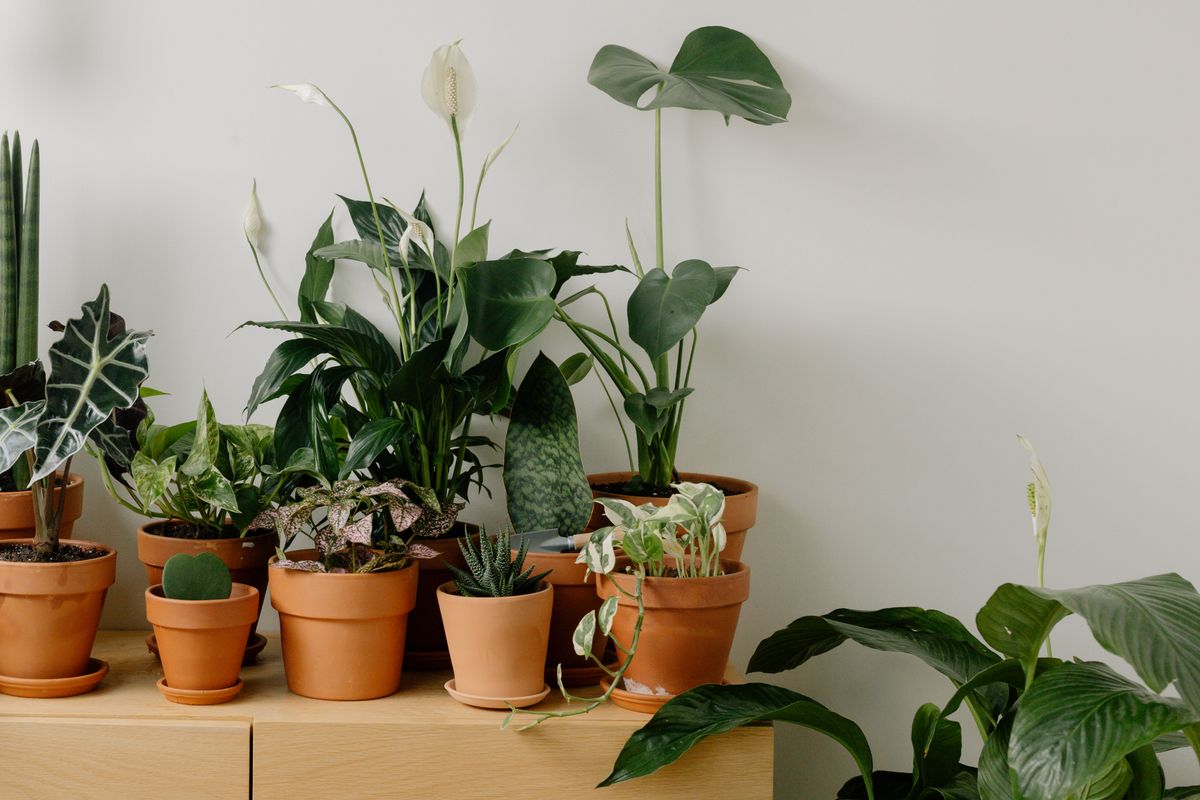
Plain unglazed clay with a drainage hole is the whole specification: a set of terracotta pots with saucers is the shape meant.
Maryland Extension describes the same porosity as a root benefit rather than a watering cost. Terracotta pots Easily absorb and lose moisture, provide excellent aeration for plant roots, encourage good root growth and roots spread out to grow near the pot's walls because moisture and nutrients accumulate in the clay pores. For plastic, its summary is practical: they Are lightweight and easy to handle, relatively inexpensive, easy to clean and sterilize for reuse and plants require less frequent watering.
So the choice is not about quality. It is a watering-frequency dial, and which way you want it turned depends entirely on what you are growing. A calathea in terracotta is a plant you will be chasing all summer, and the reasons are in calathea brown edges. A snake plant in a glazed pot with a saucer is the arrangement most likely to end in root rot.
One practical note that does not appear in either source. Terracotta's drying advantage disappears the moment the pot sits in a saucer of water or inside a decorative outer pot, because the walls can only lose water to air. Most apartment setups do one or the other.
Where the sources disagree about salt
Worth knowing if you have white crust anywhere, because the two most useful sources point in opposite directions.
Penn State credits unglazed clay with reducing waterlogging and salt buildup. Maryland credits plastic with the opposite, listing among its advantages that plants in plastic accumulate fewer soluble salts.
Both are defensible and they are probably measuring different things. Clay wicks dissolved salts out of the mix and into the pot wall, which is why old terracotta develops a white bloom on the outside: the salt left the soil. Plastic holds water longer, so less water evaporates through the sides and less salt is drawn to a concentration point in the first place. Fewer salts in the growing medium and fewer salts overall are not the same claim.
The advice that survives either reading is the same. Water thoroughly enough that some runs out of the drainage hole, and empty the saucer, whatever the pot is made of. If there is already a crust on the rim or the soil surface, that is a finding rather than a guess, and brown tips on houseplant leaves works through what it means.
Glazed ceramic and what a cachepot is
Most of the good-looking pots in an apartment are glazed ceramic with no hole in the bottom, and there is a correct way to use them.
Penn State names the object: Another option is to place potted houseplants in a potholder, also called an overpot or cachepot. These usually have no drainage holes. The instruction is direct: they are generally not suitable in which to directly plant a houseplant, and instead a potted houseplant can be slipped inside the cachepot to achieve the desired look.
Maryland says the same about glazed ceramic, noting that such pots commonly lack sufficient drainage holes but can be used with a clay or plastic pot inside to allow for drainage.
Two things to actually do with that arrangement, both easy to skip. Pour out whatever collects in the bottom of the outer pot, since a nursery pot standing in an inch of water has no drainage at all. And do not assume; you cannot see the water level from above.
One more instruction from Maryland worth repeating because it contradicts a widespread habit: when potting, Don't fill the bottom of your pot with gravel. That is a third extension service on the same point, though the evidence there is less settled than the phrasing suggests, which is the subject of the rocks in the bottom of a pot page.
When to repot a houseplant
Five signals, and one of them is easy to misread as something else.
Illinois Extension lists them plainly: Roots begin to grow through the drainage holes. Roots appear on the soil surface. The soil mass is filled with roots. New leaves are smaller than normal. The plant wilts between normal waterings.
The first three are direct observation and hard to get wrong. The last two are the interesting ones, because both are signals this site attributes elsewhere to different causes.
New leaves smaller than normal is the classic low-light symptom, and it is also what a root-bound plant does. The way to separate them is whether anything changed: light declines gradually with the season, covered in houseplant winter care, while a plant that has filled its pot has usually been in that pot for a year or more.
Wilting between normal waterings is the fourth cause of collapse, alongside the three in peace lily drooping. A pot that is nearly all roots holds very little water, so it dries out faster than it used to on the same schedule. If a plant that was fine last year now needs water twice as often, look at the roots before adjusting the routine.
Illinois adds a detail for when you do repot, which pairs with the salt discussion above: if there is a salt buildup (crusty white residue) on the soil surface, remove it by scraping away the top inch of old soil before replanting.
Expect some leaf drop afterward. Root disturbance briefly limits water uptake, and houseplant dropping leaves covers how to tell that from a real problem.
While the plant is out of its pot, look at the outside of the root ball. Clemson advises exactly that inspection because most pests found in a pot are on the exterior of the rootball, and white specks there on a plant that keeps relapsing are usually mealybugs on houseplants rather than perlite.
Best pots for houseplants, side by side
| Unglazed terracotta | Plastic or fiberglass | Glazed ceramic | |
|---|---|---|---|
| Water loss through walls | Yes, significant | None | None |
| Watering frequency | More often | Less often | Less often |
| Root aeration | Best, per UMD | Adequate | Adequate |
| Weight | Heavy | Light | Heavy |
| Drainage hole | Usually | Usually, but check | Often absent |
| Best for | Succulents, cacti, snake plant | Calathea, ferns, most tropicals | As a cachepot around a nursery pot |
| Watch out for | Drying advantage lost in a saucer | Buying one without a hole | Water pooling unseen in the bottom |
What has and has not been tested here
Nothing on this page has been tested by me, and there is nothing here to test in the usual sense.
No brand is named and no product is recommended, because the decision that matters happens above the brand: what diameter, what material, and whether there is a hole. Those three questions are answered by extension guidance and by the physics of a wet pot, both linked at every point so you can check them.
I have not compared specific pots, measured drying rates, or run a terracotta and a plastic pot side by side. Where two extension services disagree, above, I have said so rather than picking the one that made a cleaner sentence.
Common questions
What size pot should I use for a houseplant? One to two inches larger in diameter than the current pot. Illinois Extension warns against over-potting a small plant into a large one, because the soil stays too wet for too long and poor growth or root rot may result.
Terracotta vs plastic pots: which is better? Neither, and the difference is a watering dial. Penn State notes that porous clay pulls water from the mix, so clay pots need watering more often than plastic ones, and recommends terracotta for succulents and plastic for plants that like to stay moist.
When should I repot a houseplant? Illinois lists roots growing through the drainage holes, roots on the soil surface, a soil mass filled with roots, new leaves smaller than normal, and the plant wilting between normal waterings. The last two can also mean low light or a watering problem, so check the roots before concluding.
What are the signs a plant is root bound? Roots circling the inside of the pot or emerging from the drainage holes, soil that is more root than soil when you tip it out, and a pot that dries out much faster than it used to. Smaller new leaves point the same way but overlap with low light.
What is a cachepot? A decorative outer pot with no drainage hole, also called an overpot or potholder. Penn State describes it as generally unsuitable for planting directly into, and advises slipping a potted plant inside it instead. Empty any water that collects in the bottom.
Do I need to put anything in the bottom of the pot? Maryland Extension says not to fill the bottom with gravel. A shard over the hole to stop soil washing out is the only common addition worth making, and even that is optional with a modern mix.
Best pots for houseplants: one thing to check first
Measure the pot the plant is in now.
Then buy one that is an inch or two wider, which will almost certainly look too small next to it on the shelf, and will be right. The pot that looks correctly proportioned in a shop is usually two or three sizes up, and it is the single most expensive-looking way to drown a plant slowly.