
Peace Lily Drooping: Three Causes That Look Identical
A peace lily drooping means a dry pot, a waterlogged one, or nothing at all. How to tell which, and why the recovery time is the test that settles it.
Peace Lily Drooping: Three Causes That Look Identical
A peace lily drooping to the point of collapse is the plant's response to a dry pot, to a waterlogged pot, and to an ordinary warm afternoon. Three different situations, one appearance, and two of them get made worse by the standard reaction.
The reaction is to water it. That is right in one case out of three, and the fastest way to tell them apart is not the leaves at all.
The short version
- Dry pot: total collapse, and it stands back up within hours of watering.
- Wet pot: the same collapse, and watering does nothing, because the roots are failing.
- Warm afternoon: partial droop in bright light with moist soil, back to normal by morning.
- Recovery time is the test. Hours means dry. No recovery means wet.
- Even the harmless kind has a cost if it keeps happening.
Why does a peace lily collapse so dramatically?
Because it does not ration. Most houseplants curl, pale, or drop a leaf when they run short. This one goes over all at once.
The commercial growers have a word for it. University of Florida, writing for interiorscape professionals, notes that The most common problem is underwatering which causes the entire plant to severely wilt or, as it is known in the trade, "crash."
A crash looks like the plant has died in an afternoon. It usually has not. UF's own treatment column is almost dismissive: Simple and thorough watering is sufficient. Plants will resurrect in a matter of hours.
Hours. That number is the whole diagnostic. A peace lily that gets water and is upright again by evening was thirsty. A peace lily that gets water and looks the same the next morning has a different problem, and it just received more of what caused it.
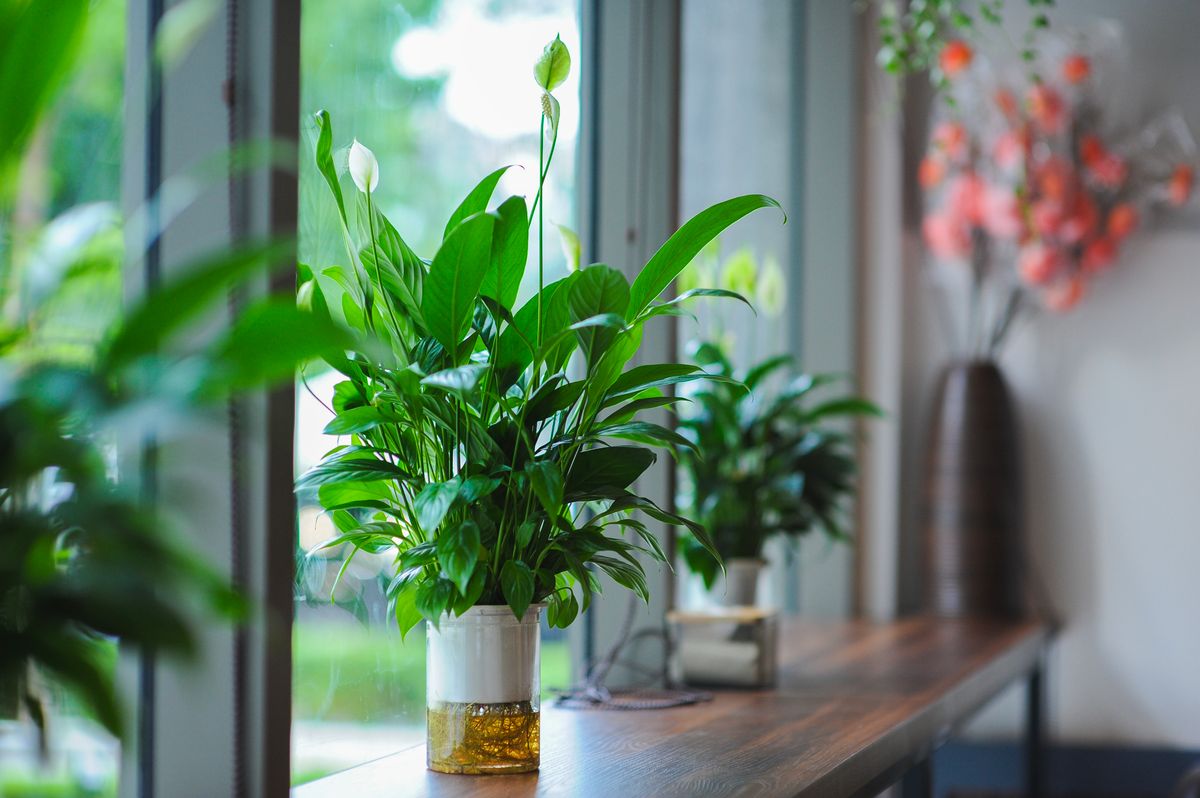
Peace lily drooping in a wet pot: the look-alike that watering makes worse
UF's diagnostic table lists a second entry with nearly the same visible symptom and the opposite cause.
Under a saturated growing medium, the description reads: Leaves wilt or collapse and sometimes develop necrosis along leaf margins. Roots are sparse, sometimes with black tips. The fix is the reverse of the instinct, which is to Reduce irrigation frequency to improve soil aeration or utilize a potting medium with a higher pore space percentage.
Roots that cannot breathe cannot move water, so the plant wilts in wet soil for the same immediate reason it wilts in dry soil. The leaves have no way to report which. This is the general case worked through in overwatering vs underwatering, and the peace lily is its most theatrical example.
Two things separate the wet version at a glance.
Necrosis along the leaf margins. A dry crash tends to be uniform limpness. A drowning plant often has dead brown tissue running along the edges of the older leaves as well.
No response to watering. The dry crash resurrects in hours. Nothing happens with the wet one, because the water was never the missing ingredient.
If it is ambiguous, tip the plant out and look at the roots. UF says what you are looking for: sparse, with black tips. Healthy peace lily roots are dense and pale. If most of what you find is soft and dark, the next question is whether enough living root remains to be worth rebuilding from, which is how to save a dying houseplant.
There is a fourth cause, less common but worth ruling out on an older plant. Illinois Extension lists wilting between normal waterings among the signs a plant needs repotting, because a pot that is mostly root holds very little water. If this plant has been in the same pot for years and has started drying out twice as fast as it used to, see best pots for houseplants.
One seasonal note from the same entry connects to the rest of the site. UF flags that this failure is more likely to occur during cold weather, for the reason the same sentence gives, which is that a plant in the cold needs less water than it did. A winter watering routine that has not changed since summer is the standard route into it, covered in houseplant winter care.
Peace lily drooping every afternoon, which is normal and still costs you
The third state gets left out of almost every article about this plant, and it is the one that makes people water on a schedule they do not need.
UF adds it as a caveat to the crash entry: Plants may droop in the late day if they are in bright light and temperatures are above 80-85°F even though potting mix is moist. This is normal.
A peace lily in a warm bright spot can lose water through its leaves faster than the roots resupply it during the hottest hours, sag, and recover overnight without anything being wrong. Watering it at that moment adds water to a pot that already has some, which over a summer is how a plant ends up in the second category.
The caveat has a caveat, though, and it is the useful part: However, frequent drooping will result in brown tips and edges. Normal is not the same as free. A plant that collapses every afternoon is telling you the position is too bright or too warm for it, and it will bill you in leaf tips.
| Dry crash | Wet collapse | Afternoon droop | |
|---|---|---|---|
| Soil feels | Dry two inches down | Wet, often for days | Moist |
| How far it goes | To soil level | To soil level | Partial |
| After watering | Upright in hours | No change | Not applicable |
| By next morning | Fine | Still down | Fine, on its own |
| Edges | Usually clean | Brown necrosis common | Brown tips if repeated |
| What to do | Water thoroughly | Water less, check roots | Move it, do not water |
How often should you water a peace lily?
On what the pot weighs, not on a day of the week.
Maryland Extension names this plant as the specific exception to reading a wilt as thirst: Certain plants like peace lily (Spathiphyllum) will wilt when they need to be watered although plants can also wilt if they are overwatered too. Having said that the leaves are unreliable, they give the alternative: Another quick test is to lift the plant, pot and all, to check its weight change. The plant with dry potting medium will weigh much less than the plant which still has ample water in its potting medium.
Lift it right after a thorough watering, and lift it again when the soil is dry two inches down. Those two weights are the range, and after a week of doing it the answer takes a second. A peace lily is worth learning this on, since it is the plant most likely to lie to you.
Clemson's target is a narrow band: Soil should be kept moist but not soggy and allowed to dry out slightly between waterings, with a clear consequence at each end. Too dry and the plant will wilt, and the leaves and edges will turn yellow. Too wet, and the instruction is to never let the plant sit in a saucer of excess water, as this will lead to root rot issues.
Emptying the saucer is most of the battle, and a pot that drains freely is the rest of it, which is the subject of rocks in the bottom of a pot.
Do peace lilies grow in low light?
Yes, and they are one of the very few that will also flower there.
Clemson gives them a distinction worth knowing if your apartment has one dim room: peace lilies are one of the few foliage plants that will flower in low light. Most plants sold as low-light tolerant hold their leaves and give up flowering entirely, which is covered in north-facing window plants.
Tolerance is not preference. UF's care sheet asks for Bright, indirect light. No direct sun, and the grower guidance is explicit that too much light burns them: excess light produces leaves that are curled, pale, and chlorotic to necrotic, with the note that These plants will sunburn.
Clemson names the trade-off directly when it comes to blooming, listing insufficient light as a cause of a plant that will not flower, alongside simply being young. A peace lily in a north room is a plant that lives; a peace lily a few feet from an east window is a plant that flowers.
Cold is the other limit, and it arrives lower than most people watch for. UF puts the threshold plainly on its care card: active growth is reduced at or below 50°F, and its diagnostic table lists cold injury that can be both visible and invisible. A winter windowsill is a real risk for this species specifically, and the experiments behind that are in houseplant cold damage.
Peace lily brown tips: fertilizer before humidity
Worth checking in an unusual order for this plant, because the most likely cause is one you added on purpose.
Clemson is blunt about how little it wants: These plants need very little fertilizer, recommending a balanced liquid feed every six to eight weeks during the spring and summer growing season and, notably, at one-quarter of the recommended strength. Going past that has a specific signature: Overfertilizing peace lilies can cause the leaf tips and roots to burn and turn brown.
UF's commercial table reaches the same conclusion from the grower's side, pairing burned tips and roots with excessive fertilizer, and advising interior plants be fed at a quarter of commercial strength.
So the running order for brown tips on this plant is fertilizer, then the frequent-drooping cause above, then everything in brown tips on houseplant leaves. Humidity is the last suspect rather than the first, which is the reverse of how it usually gets diagnosed.
Are peace lilies toxic to cats?
Yes, though not in the way the name suggests, and the distinction matters a great deal.
ASPCA lists Spathiphyllum as toxic to dogs and cats, with the toxic principle given as Insoluble calcium oxalates and the effects as Oral irritation, intense burning and irritation of mouth, tongue and lips, excessive drooling, vomiting, difficulty swallowing. Clemson describes the same mechanism, noting calcium oxalate crystals in the plant cells and that The most common side effect is burning of the mouth, throat, and tongue.
The important part for a cat owner is what a peace lily is not. It is not a true lily. ASPCA, writing about lily toxicity generally, says of true lilies that small amounts can cause severe injury to the kidneys, which is a life-threatening emergency. For peace lilies the same organization writes that While Peace lilies are toxic, it is very rare for them to cause serious or life-threatening problems.
Painful, then, rather than dangerous, in the usual case. Keep it where a cat does not chew it, and if one does, call a vet rather than guessing. ASPCA Poison Control is on (888) 426-4435.
The peace lily shares its toxin with most other aroids, so the same reasoning covers pothos, philodendron and anthurium: houseplants toxic to cats and dogs sorts the common ones by chemical group and lists Clemson's non-toxic alternatives.
Why is my peace lily drooping?
Most often a dry pot, and the check takes hours rather than days. Water it thoroughly; UF says a peace lily that crashed from lack of water will resurrect in a matter of hours. If it is still down the next morning, the soil was probably already wet and the roots are the problem.
One thing to do next time it collapses
Note the time.
Water it thoroughly, write down the hour, and check it before bed. A peace lily drooping from thirst is standing up again in that window, and one that is not has told you something the leaves could not: the water was already there, and what is failing is underneath the soil where you cannot see it.