
The IKEA Greenhouse Cabinet: What It Solves and What It Creates
An IKEA greenhouse cabinet holds humidity a room cannot, and creates the still, damp air gray mold prefers. Put a fan in the first purchase.
The IKEA Greenhouse Cabinet: What It Solves and What It Creates
A greenhouse cabinet solves a real problem, and it is the one left over at the end of every humidity discussion: an open room is too large to hold moisture around a plant. Shrink the space and a small amount of water vapor is finally enough to change it.
It also builds something you should go in knowing about. Warm, damp, still air with plants pressed close together is the environment fungal disease prefers, and every one of those conditions is on the design brief. That is not an argument against cabinets. It is the reason the fan matters more than the weatherstripping.
Most build guides treat air movement as a refinement to add later. It belongs in the first purchase.
The short version
- A cabinet works because it is small, which is the one thing a room cannot be.
- Gray mold likes 60 to 70°F with humidity above 85 percent, which is a fair description of a planted cabinet.
- Air circulation is what makes high humidity survivable, and there is a source saying so directly.
- Do not pack it. Overcrowding is on the list of causes alongside humidity.
- Budget for six things, not one, and put a hygrometer in before anything else.
Why an IKEA greenhouse cabinet works at all
The humidity article ends on a structural point: passive methods lose to the volume of the room. A pebble tray adds moisture, and that moisture then spreads out into every cubic foot of a bedroom, so what reaches the plant is negligible.
A cabinet changes the denominator. The same small amount of evaporation released into roughly thirty cubic feet instead of two thousand produces a completely different reading, which is why enclosures keep appearing among people growing plants that want tropical humidity in ordinary apartments.
Nothing exotic is happening. You are not adding more water, you are giving it less room to disappear into.
What you are also building
NC State Extension is specific about what gray mold wants: Optimum conditions for the growth of B. cinerea are temperatures from 60-70 °F coupled with high relative humidity (>85%).
Compare that with a planted cabinet in a heated apartment. Room temperature sits in that band. Humidity above 85 percent is the target people are trying to hit in a sealed cabinet, rather than an accident.
The same page states the inverse, which is where your control actually lives: When temperatures are greater than this range and/or when humidity is low, gray mold does not develop. Both conditions have to line up. A cabinet is a machine for making them line up.
Iowa State University Extension lists the causes for both gray mold and powdery mildew in identical terms: Caused by overcrowding, low light, poor air circulation, and/or high humidity.
Four causes. A glass cabinet is a strong candidate on all four: plants packed in because space is expensive, light that is often marginal at the lower shelves, air that does not move because the doors are shut, and humidity that is the entire point of the exercise.
There is one more line worth sitting with. NC State advises avoiding periods of high humidity longer than 3 hours per day. A greenhouse cabinet is a device for maintaining high humidity continuously. That advice is written for commercial growers who can control a whole greenhouse, and it is not a reason to abandon the idea, but it does tell you how seriously the risk is taken by people who do this professionally.
Iowa State also has the sentence that decides how you should think about all of this: Remember that most fungicides prevent the spread of disease issues but do not cure current infestations.
There is no product that fixes this after the fact. Environment is the control.
Air circulation is the part that makes it safe
A fan is not an upgrade. NC State states it plainly: Adequate air circulation, even when humidity is high, can greatly reduce the development of gray mold.
High humidity and stagnant air are two separate variables, and you only need to sacrifice one of them. The cabinet exists to hold the humidity. A small fan means you do not also have to hold the air still.
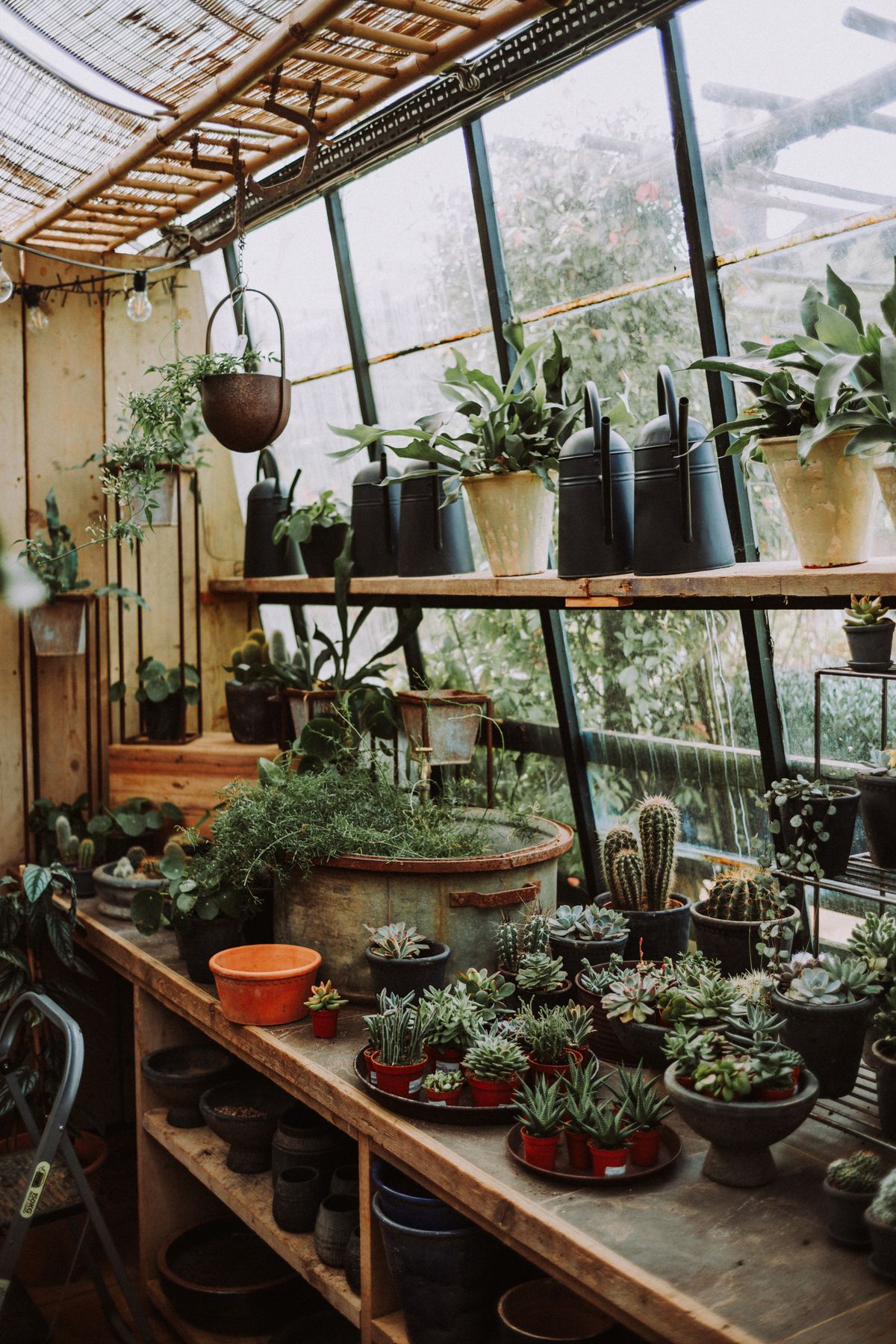
Practically, that means a quiet clip fan or a USB fan moving air gently inside the cabinet rather than blasting at the leaves, positioned so there is no dead pocket in a corner. NC State's own guidance for growers includes adjusting fan placement to eliminate dead air spots, which scales down to a cabinet: if you can see condensation sitting permanently on one part of the glass, air is not reaching there.
As an Amazon Associate, Apartment Botany earns from qualifying purchases. Prices change, so check the current listing.
A small USB clip fan does this and clamps to a shelf edge without drilling anything.
Two related habits from the same source. Keep water off the foliage, since NC State recommends Drip irrigation is recommended to avoid prolonged periods of leaf wetness and spore dispersal via water splash, which in a cabinet means watering at the soil rather than misting the leaves. And take dead material out promptly: Remove dead portions of the plants and dispose of them outside of the greenhouse or facility. Gray mold, per Iowa State, is very common on flowers or dying flowers, so a spent bloom left on a shelf inside a humid box is an invitation.
Worth noticing that misting is on the wrong side of this too. Iowa State attributes leaf spots to wet leaves (usually from misting or watering), poor air circulation, and/or overcrowding. Misting was already useless for humidity. Inside a cabinet it is actively counterproductive.
Do not fill it
The temptation with a cabinet is to fill every shelf, because shelf space is what you paid for.
Overcrowding sits on Iowa State's cause list next to humidity, and it is the one variable that costs nothing to fix. Plants pressed against each other hold pockets of still, wet air between their leaves no matter what the fan is doing at the front of the cabinet.
A cabinet at half occupancy with air moving through it is a better environment than the same cabinet packed solid. This is unwelcome advice, since it means the expensive thing you bought should be used at less than capacity, but it is cheaper than losing the collection.
The parts list, and what each piece is for
Six items, and they are not equally optional.
| Part | What it does | Status |
|---|---|---|
| Cabinet | Shrinks the volume so humidity is achievable | Required |
| Fan | Keeps air moving so high humidity does not become disease | Required |
| Hygrometer | Tells you what is actually happening inside | Required, and buy it first |
| Grow light | Glass cabinets are dim, especially lower shelves | Required for most plants |
| Humidifier | Raises humidity actively rather than hoping | Usually needed |
| Smart plug or timer | Runs light and humidifier on a schedule | Strongly recommended |
For the two items that need no choosing, a basic digital hygrometer and a Wi-Fi smart plug are the ordinary kind; the light and the humidifier are where the decisions are.
On the cabinet itself, four IKEA models get converted into plant enclosures, and their measurements and prices below were checked directly against ikea.com/us rather than copied from another build guide.
| Cabinet | Inside dimensions (W x D x H) | Price (US) | Checked |
|---|---|---|---|
| MILSBO | 28 3/4 x 16 1/2 x 68 7/8 in | $279.99 | September 2026 |
| RUDSTA, tall | 16 1/2 x 14 5/8 x 61 in | $149.99 | September 2026 |
| RUDSTA, wide | 31 1/2 x 14 5/8 x 47 1/4 in | $179.99 | September 2026 |
| FABRIKÖR | 22 1/2 x 18 1/2 x 59 in | $179.99 | September 2026 |
MILSBO is the tallest by a wide margin, which is also why it is the cabinet most build guides online were written around: more height means more stacked shelves, and the fan-and-shading logic above applies to every one of them.
The wide RUDSTA is worth a second look for a different reason. At 47 inches it is the shortest of the four, which likely means fewer shelves stacked on top of each other, and this article's whole argument about lower shelves being darker and more crowded is a function of how many shelves are doing the stacking. A short, wide cabinet trades vertical capacity for a build where the shading problem is smaller to begin with.
DETOLF, the fourth model and the one older build guides usually default to, is not on this table because its US product page now redirects to IKEA's general storage category instead of showing a price. That is IKEA's own signal that it is not currently sold new in the US. It is still listed on some non-US IKEA storefronts and shows up secondhand, but any DETOLF price you see quoted for a US build should be treated as a resale price, not a current retail one.
On the light, a glass box is darker than it looks and the lower shelves are darkest. What the specifications actually mean, and why mounting distance decides whether a lamp is worth buying, is in grow lights for houseplants.
On the humidifier, the type matters more than the model, because the EPA names specific designs as capable of sending minerals and microorganisms from the tank into the air. That, plus the cleaning schedule, is covered in humidifiers for houseplants.
What an IKEA greenhouse cabinet costs
Adding it up honestly: the cabinet is the largest single line, the light is the second, and the small parts total more than people expect. A realistic build lands somewhere in the low hundreds rather than the tens, and that is before replacement humidifier filters or a second light for the lower shelf.
The cabinet planner turns that into your own numbers: volume, the light each planted shelf needs, and what the finished thing adds to the electricity bill each month.
Two ways to spend less. Start with the cabinet and the hygrometer alone, run it for a week, and find out what the enclosure does on its own before buying anything to correct it. And resist buying the humidifier first, since a closed cabinet with plants in it is already more humid than the room, and you may need less machine than you think.
When not to build one
If your plants are pothos, snake plants, ZZ plants and philodendrons, this is over-engineering. Those are the plants that tolerate ordinary apartment air, and putting them in a humid box adds disease risk in exchange for a benefit they were not asking for.
The case for a cabinet is specific: plants that genuinely want tropical humidity and are visibly failing without it, in a home that cannot provide it. Calatheas, many ferns, and a lot of the aroids people struggle with in winter fit that description. Ordinary foliage plants do not.
Calathea is the clearest candidate, because it wants humidity above 60 percent and stable temperatures at the same time, and a cabinet is the only thing that supplies both at once: see calathea brown edges for what it is actually asking for before you build anything around it.
If you are here because of brown leaf tips, check the cheaper explanations first. Brown tips on houseplant leaves sorts the visible causes from the invisible one, and a cabinet is an expensive answer to a question that is often salt in the soil.
What has and has not been tested here
I do not own a greenhouse cabinet and have not built one.
Everything above about disease conditions comes from NC State Extension and Iowa State University Extension, linked at each point, and the cabinet dimensions and price come from IKEA's own product page on the date noted. What I have not done is run one of these through a winter, measure how much a given fan changes the humidity gradient inside, or compare cabinet models in use.
That is also why there is no parts recommendation by brand here beyond the type-level guidance in the linked articles. The useful decisions in this build happen at the level of what each part is for and whether you can keep the air moving, and those do not require me to have bought anything.
Common questions
Do you need a fan in a greenhouse cabinet? Yes, and it is the part most build guides treat as optional. NC State Extension states that adequate air circulation, even when humidity is high, can greatly reduce the development of gray mold. The cabinet supplies the humidity; the fan is what keeps that humidity from also meaning stagnant air.
What greenhouse cabinet humidity should you aim for? High enough for the plants you are keeping, and monitored rather than assumed. Note that NC State places gray mold's preferred range above 85 percent relative humidity at typical room temperatures, so the closer you run to that, the more the air circulation and plant spacing matter.
How do you prevent mold in a greenhouse cabinet? Keep air moving, do not overcrowd the shelves, water at the soil rather than misting the foliage, and remove dead leaves and spent flowers promptly. Iowa State notes that most fungicides prevent spread but do not cure existing infections, so prevention is the whole strategy.
Which IKEA cabinet is best for plants? MILSBO, RUDSTA and FABRIKÖR are currently sold new in the US and commonly converted. MILSBO is the tallest at 68 7/8 inches and holds the most stacked shelves. RUDSTA comes in a tall narrow size and a short wide size, and the short wide one has the fewest shelves shading each other. FABRIKÖR sits between the two on both height and price. DETOLF, the model older build guides default to, is no longer sold new on the US IKEA site.
Is a greenhouse cabinet worth it? For plants that genuinely need humidity you cannot provide in the room, yes. For pothos, snake plants and other tolerant foliage, no. It adds cost and disease risk to solve a problem those plants do not have.
One thing to do before buying anything else
Put a hygrometer in the empty cabinet, close the doors, and leave it a week.
You will find out what the enclosure does on its own, with no equipment and no plants at risk, and that number tells you whether you need a humidifier at all or just a fan and some patience. It is the cheapest week of research an IKEA greenhouse cabinet allows, and it happens before the expensive decisions rather than after them.