
How to Increase Humidity for Houseplants (and What Does Not Work)
How to increase humidity for houseplants: two extension services agree misting does nothing and disagree about pebble trays. What that split tells you.
How to Increase Humidity for Houseplants (and What Does Not Work)
Two university extension services agree that misting does nothing for humidity. They disagree about pebble trays. The reason behind that disagreement is more useful than either verdict, because it explains why almost everything people try in an open room underdelivers.
If you are here because of brown leaf tips, read brown tips on houseplant leaves first. Humidity is the cause everyone reaches for and the only one you cannot check without a meter, so it is worth ruling out the visible explanations before spending anything on this one.
The short version
- Buy a hygrometer before anything else. A few dollars turns a guess into a number.
- Misting does not work. Both sources say so, and one gives the timescale in minutes. A third, Minnesota Extension, says the same specifically about ferns, which is where the habit is strongest: Boston fern dropping leaves.
- Pebble trays are contested. One extension service recommends them, another says they make almost no difference, and the mechanism explains why.
- Grouping plants helps a little, in proportion to how many plants and how big the room.
- A humidifier is the honest answer for a whole room, and even then a whole-house unit will not reach what plants prefer.
What humidity do houseplants actually need?
The two sources give different numbers, and the difference is worth understanding rather than averaging.
Iowa State University Extension states a plant preference: Many houseplants prefer a relative humidity of 40 to 50 percent.
Penn State Extension cites a building standard instead: The American Society of Heating, Refrigerating, and Air Conditioning Engineers (ASHRAE) recommends that indoor relative humidity (RH) be maintained between 30% and 60%.
Those are not competing claims about plants. ASHRAE's range is written for buildings and the people in them, covering comfort, condensation and building fabric. Iowa State's is about what foliage plants prefer. A home held at 35 percent is inside the ASHRAE range and below what Iowa State says most houseplants want, and both statements stay true at once.
Which is why the first purchase is not a humidifier. It is a hygrometer, sitting next to the plant rather than across the room, read in the evening when the heating has been running longest. Without that number you are treating a condition you have not confirmed, and you will not be able to tell whether anything you do afterward worked.
Misting: the one thing both sources reject
Misting is the most widely practiced humidity ritual in the hobby, and neither source supports it.
Penn State gives the mechanism and the timescale: After a plant is misted, a rise in humidity only lasts until the water evaporates. This can happen in a matter of minutes, so even daily misting does nothing to raise the humidity levels around a plant.
Iowa State reaches the same conclusion from the practical end, stating that Misting houseplants is not an effective way to raise the relative humidity. Plant foliage dries quickly after misting. Its separate answer on misting spells out what it would take to matter: Plant foliage dries quickly after misting. Misting would have to be done several times a day to be effective.
Two things are worth separating here. Misting is harmless in normal use, and the pleasure of doing it is real. What it fails at is treating dry air, because the water you put on a leaf is gone before it has changed the air around it. If a plant is genuinely suffering from low humidity, misting it once a morning lands closer to no solution than to a partial one.
Pebble trays: where the sources split
Here the two disagree outright, and their disagreement is the most useful passage on the page.
Iowa State recommends them, with instructions: Place houseplants on trays (saucers) filled with pea gravel or pebbles. Add water to the trays, but keep the bottoms of the pots above the water line. The evaporation of water from the trays increases the relative humidity.
Penn State says the effect does not survive contact with the room: The evaporated air diffuses into the entire room, making almost no overall impact on the relative humidity.
Both are describing the same physics and drawing the line in different places. Water does evaporate from the tray, so Iowa State is right that humidity is being added. It then mixes into the whole volume of the room, so Penn State is right that the measurable change where the plant sits is small. The disagreement is about whether a small local effect counts as working.
And that is the genuinely useful part, because the same logic applies to everything passive you might try in an open room. Any moisture you release has to compete with the volume of air it is released into, and a room is very large compared with a saucer of gravel. This is the reason the humidity advice you find generally underperforms: not because the methods do nothing, but because the room is winning.
Two practical conclusions follow. If you use a pebble tray, expect a small effect immediately around the plant rather than a changed room, and do not treat it as having solved the problem. And if you want more than that, you have to either add moisture at a rate that matters for the whole room, or make the space around the plant smaller.
Grouping plants: modest and real
Iowa State describes the mechanism plainly: Grouping plants together is an easy way to raise the humidity level. The water evaporating from the potting soil, plus water lost through the plant foliage, will increase the relative humidity in the vicinity of the houseplants.
Penn State agrees but qualifies it in a way that is more helpful than a plain endorsement: This is a simple step that most sources still deem beneficial. Its effectiveness most likely depends on the number of plants and the size of the room they occupy.
That qualifier is the honest version. Three pots on a windowsill in a large room will not change much. A dozen plants close together on a shelf in a small room is a different situation, because now the plants themselves are a meaningful source of moisture in a limited volume. It is free, it costs nothing to try, and its size scales with how committed you already are.
Humidifiers: the honest answer, with a limit
Both sources back humidifiers, and Iowa State is unreserved: Humidifiers are an excellent way to increase the relative humidity in the home.
Some plants make that a requirement rather than an improvement. NC State's care entry for the areca palm names a humidifier in the instruction itself, which is a stronger position than most houseplant entries take: areca palm dying.
Penn State adds the caveat that matters for anyone considering the built-in option: Adding a humidifier to a hot air heating system is beneficial both for human comfort and for houseplants. Although a whole-house humidifier will not raise the humidity to ideal levels for houseplants, it will help.
So even the serious version of this solution falls short of plant-preferred levels when it is asked to treat an entire house. A portable unit running in one room is working against a much smaller volume, which is why it can achieve what the whole-house version cannot.
If you get that far, the type you buy matters more than the feature list, because the EPA names specific designs as capable of sending minerals and microorganisms from the tank into the air. That, and the cleaning schedule that comes with owning one, are covered in humidifiers for houseplants.
What the disagreement tells you about how to increase humidity for houseplants
Put the four methods next to each other and a pattern appears.
| Method | Iowa State | Penn State | What limits it |
|---|---|---|---|
| Misting | Not effective | Does nothing beyond minutes | Water is gone before the air changes |
| Pebble tray | Recommended | Almost no overall impact | Moisture diffuses into the whole room |
| Grouping | Raises humidity nearby | Beneficial, depends on scale | Needs enough plants in a small enough room |
| Humidifier | Excellent | Helps, whole-house falls short | Must out-supply the volume it serves |
Every entry fails or succeeds for the same reason: the size of the space you are trying to change. Misting loses to time, a pebble tray loses to room volume, grouping wins only when plants are dense and the room is small, and a humidifier succeeds exactly to the extent that it can keep up with the volume it is serving.
Which leaves two real options for a plant that genuinely needs more moisture than your apartment provides. Add water to the air fast enough to matter, which means a humidifier sized to a room rather than a house. Or shrink the space, so that a small amount of moisture is enough to change it, which is what a glass cabinet does and why that approach keeps appearing among people growing high-humidity plants indoors. Building rather than buying is the whole premise of the setups section.
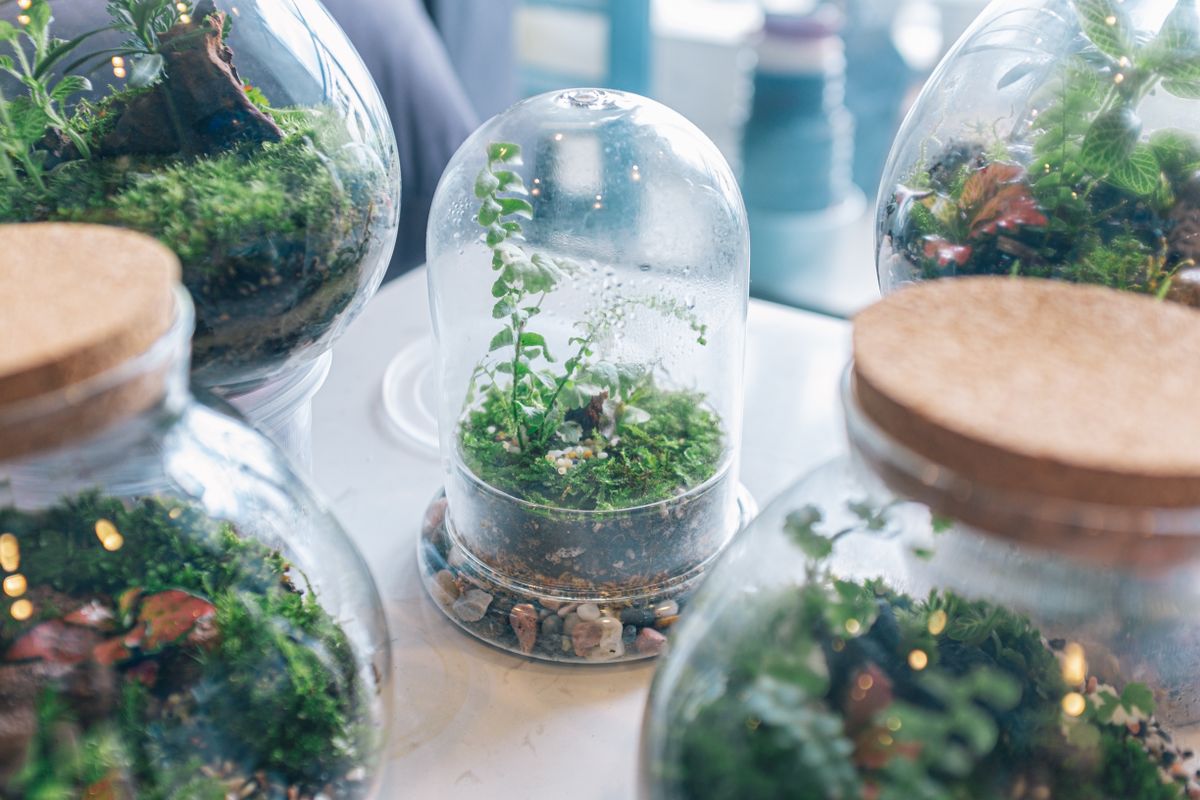
The second option comes with a condition attached. Warm, damp, still air is what fungal disease prefers, so an enclosure has to move air as well as hold moisture: see the IKEA greenhouse cabinet for what the sources say about that and what the build actually needs.
Everything else is worth doing only if you accept it as a small adjustment rather than a fix.
One argument for humidity that is not about leaves
Dry air does not only dehydrate foliage. It also removes the brake on an animal that is otherwise held in check outdoors.
Clemson notes that in indoor or greenhouse settings, higher humidity can reduce spider mite populations and the damage they do, and Wisconsin dates the indoor outbreaks to November, when the heating starts. So whatever you conclude about pebble trays, the humidity question has a second consequence that arrives in winter with legs: spider mites on houseplants.
One room gets proposed as the free version of all of this, and it is worth measuring before trusting: bathroom plants for low light covers why a shower raises the peak rather than the baseline, and why the light in there decides more than the damp does.
Do plants increase humidity in a room?
Yes, and the size of the effect is the part worth getting right, because it is what decides whether this is a solution or a rounding error.
The mechanism is quoted above: water evaporating from the potting mix plus water lost through foliage raises relative humidity in the vicinity of the plants. Whether that is measurable across a whole room is a different question, and Penn State's qualifier is the honest answer to it, since effectiveness depends on the number of plants and the size of the room they occupy.
So do indoor plants increase humidity enough to matter? Around themselves, yes, which is why grouping works. As a way to humidify a room you also live in, a few pots will not do it, and that is the version of this claim that gets repeated without the qualifier attached.
Common questions
Does misting plants actually work? Not for humidity. Penn State states that the rise lasts only until the water evaporates, which can be minutes, so even daily misting does nothing to raise humidity around the plant. Iowa State says the same and notes it would have to be done several times a day to be effective.
Do pebble trays work for humidity? The sources disagree. Iowa State recommends them and gives instructions; Penn State says the evaporated moisture diffuses into the whole room, making almost no overall impact. Both are consistent with the physics, and the practical reading is that any effect is local and small.
What humidity do houseplants need? Iowa State says many houseplants prefer 40 to 50 percent relative humidity. Penn State cites ASHRAE's recommendation of 30 to 60 percent for indoor spaces generally, which is a building standard rather than a plant requirement.
How can I raise humidity without a humidifier? Group plants together in the smallest room you can, and accept that the effect is proportional to the number of plants and the size of the space. Beyond that, enclosing the plants is the only passive approach that meaningfully changes the air around them.
Is a humidifier for plants worth it? For a room, yes, and both sources support it. Note Penn State's caveat that a whole-house humidifier will not reach the levels houseplants prefer, so a portable unit serving one room is the version that does the work.
How to increase humidity for houseplants: one thing to do first
Spend the few dollars on a hygrometer before you spend anything on a solution.
Put it beside the plant that is struggling, not on the far wall, and look at it in the evening. If it reads within the range plants prefer, humidity was never your problem and the answer is somewhere in brown tips on houseplant leaves instead. If it reads well below, you now have a number to improve and a way to tell whether anything you try afterward did anything at all. Every method for how to increase humidity for houseplants on this page is arguable except that one, and the argument is only settleable with a reading.