
Aloe Plant Dying? Two Causes That Need Opposite Treatments
An aloe plant dying is usually too much water or too little light, and the two look alike. One of them gets worse if you do the obvious thing.
Aloe Plant Dying? Two Causes That Need Opposite Treatments
An aloe plant dying in an apartment is almost always one of two things, and they call for opposite responses. One is a watering problem that gets worse every time you water it. The other is not a health problem at all, it is a plant reshaping itself to catch more light, and it is the one people misread as death.
Telling them apart takes a chopstick and a look at the roots. Both are free.
The short version
- A flattening, opening rosette is a light problem, not a dying plant.
- Soft, mushy, yellowing leaves mean too much water, and it looks like thirst.
- The classic mistake is watering a rotting aloe because it looks dehydrated.
- A chopstick settles it before you water anything.
- Stretched growth does not shrink back. Cutting and re-rooting is the fix.
Why is my aloe plant drooping?
Because it is opening up to see more sky, and that flattening is the single most misread thing an aloe does.
Iowa State describes the response precisely: Those succulents with rosette growth forms often open up and leaves flatten out in an effort to collect more light. An aloe is a rosette. In a room that is too dim, it stops holding its leaves upright in a tight cup and lets them fall outward and flat, because a flat leaf presents more area to a weak light source than an upright one does.
That reads as drooping. It reads as a plant giving up. It is closer to the opposite: the plant is spending energy on a deliberate change of shape.
The accompanying signal confirms it. Iowa State: Tall, spindly, lanky new growth that is pale in color is an indication that light levels are too low. Pale, stretched, and flat. If your aloe is doing all three and the leaves are still firm, you have a light problem and no watering change will touch it.
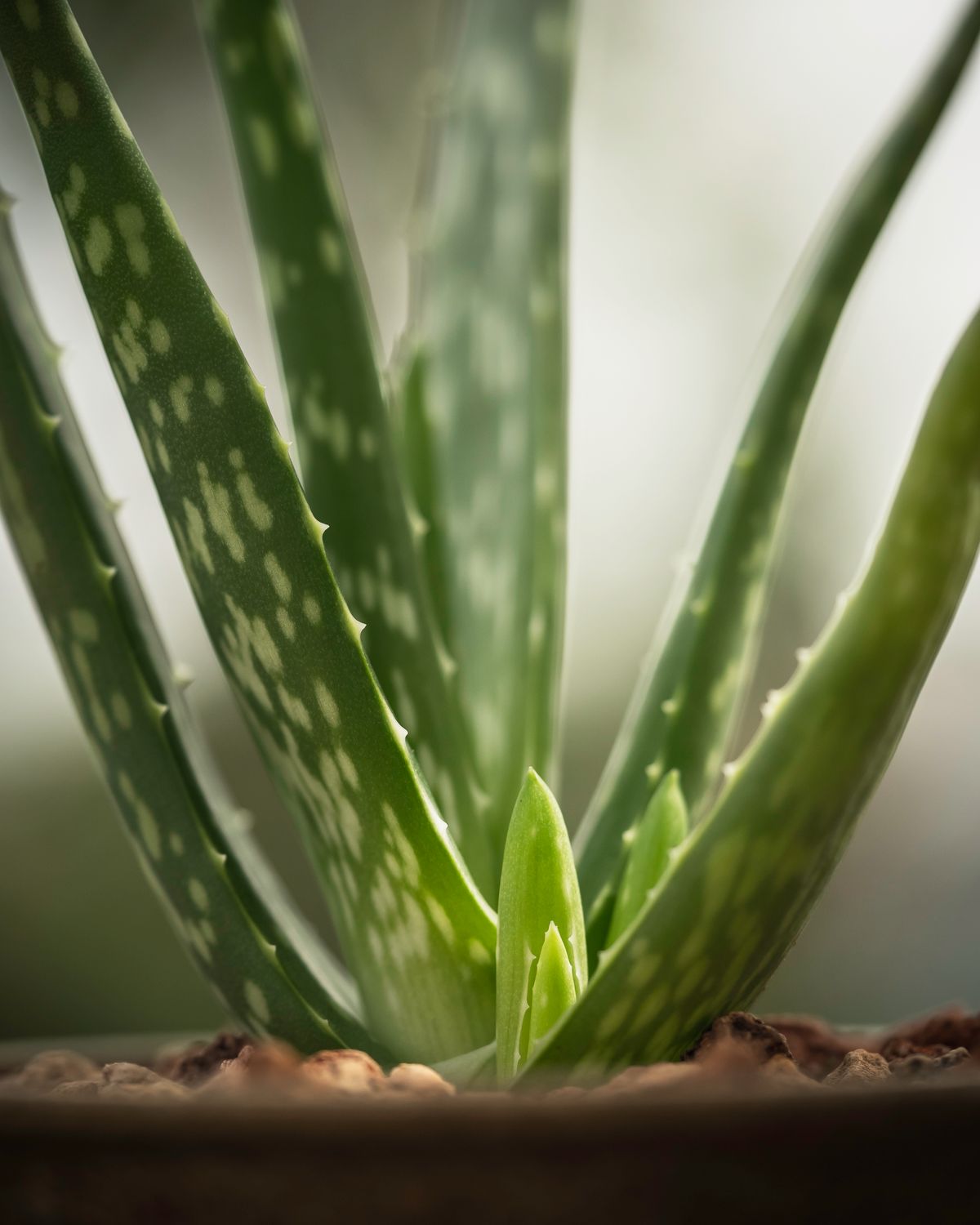
The distinction that matters, and it takes one squeeze:
| Flopping from low light | Collapsing from rot | |
|---|---|---|
| Leaf feel | Firm, still plump | Soft, mushy, squashy |
| Color | Pale green, washed out | Yellow, translucent, browning |
| Base of plant | Solid | Soft, sometimes smells |
| Soil | Any | Wet or damp to the touch |
| New growth | Long, thin, pale | Little or none |
The mistake that leaves an aloe plant dying of care
Iowa State names it in one sentence, and it is the reason this plant has a reputation for dying suddenly.
Describing root rot: With fewer roots to absorb water, plants begin to show symptoms of water stress by dropping leaves or shriveling up. Then the trap: These symptoms are often confused for underwatering and more water is added further exacerbating the problem.
A rotting aloe looks thirsty. Fewer working roots means less water reaching the leaves, so the plant shrivels exactly as it would in a drought, in soil that is already too wet. Every watering from that point makes it worse, and the plant appears to decline despite attentive care, which is precisely what it is dying of.
What over-watering actually looks like, per the same page: Plants that are growing in wet conditions will have yellowing leaves as well as soft and mushy leaves and stems. Over time, leaves will drop off. The soil surface will be wet or damp to the touch and when severe you will see mold or fungus gnats.
Mold on the surface or gnats in the air are late confirmations, and both have their own pages here: white mold on houseplant soil and fungus gnats.
Genuine underwatering looks different: When underwatered, leaves often turn yellow, shrivel, and brown before dropping off. Stems and leaves may become wrinkled and mottled. Wrinkled rather than mushy is the word to hold on to.
The chopstick test, before you water anything
Free, and it removes the guess that kills the plant.
Wood darkens where it is damp, which makes the reading visible rather than a judgment about how something feels. It reaches the middle of the pot rather than the top inch, which is where an aloe's problem actually lives, and it costs nothing. This is the same reasoning behind the pot-weight method in moisture meter for houseplants, and for a succulent the chopstick is the better of the two because the intervals are so long.
If the stick comes out dark and your aloe still looks dehydrated, stop. That combination is the rot signature, and the next step is the roots rather than the watering can.
Aloe plant turning yellow: check the roots
Yellow with soft is a root question, and the answer decides whether this is a rescue or a disposal.
Tip the plant out. Firm pale roots with fine feeders mean there is something to work with; mushy brown or reddish roots mean rot, and how much is left decides the rest. The full procedure, including the point at which two extension services recommend discarding the plant, is in how to save a dying houseplant.
Iowa State gives the succulent-specific version of that verdict, and it includes an option the general case does not: Sometimes plants can recover from root rot when allowed to dry out. Other times the rot is so advanced that the plant cannot recover. Discard the plant or propagate healthy-looking segments.
Propagate healthy-looking segments. An aloe that cannot be saved as a plant can often be saved as a cutting, which is a real difference from a fern or a peace lily in the same state. A firm top, or a pup at the base, is a whole plant that does not have the rot.
Their prevention is a rhythm rather than a schedule: Setting up a wet-dry cycle where the soil is completely wetted and then allowed to completely dry out is the best way to avoid root rot in succulents.
How often to water aloe indoors
By season and by soil, not by calendar.
Penn State splits the year: During the growing season, from early spring to early fall, water thoroughly when the soil's surface is dry, and During the dormant period, from fall through winter, reduce watering so the soil is barely moist, and the leaves don't shrivel.
NC State is blunter on the interval and adds the container: Allow the soil to completely dry between waterings. The pot used should also have several drainage holes and clay is best, with Water less frequently in the winter months.
Clay is best, which is the terracotta argument from best pots for houseplants applied to the plant it suits most: porous walls lose water, which is a nuisance for a calathea and exactly what an aloe wants.
For the mix, Penn State gives a recipe: one part potting soil, one part sand, and one part perlite or lava rocks. That is a third organic, which lines up with the two-thirds mineral ratio in growing succulents indoors.
How much light, and the two ways the sources measure it
Both figures are worth having, because they are stated in different currencies.
NC State files aloe under Full sun (6 or more hours of direct sunlight a day) and Partial Shade (Direct sunlight only part of the day, 2-6 hours). Iowa State measures the same requirement as duration of bright light instead: Ideally, plants receive ten or more hours of light a day.
Penn State's practical version for indoors: place them near sunny windows so they can receive full sun to bright indirect light, with two habits attached. Periodically rotate the container to ensure all sides of the plant receive adequate light, which matters for a rosette that will otherwise lean, and Grow lights are a good option if you don't have adequate natural lighting.
In a northern winter neither figure is reachable from a window, for the arithmetic reason set out in growing succulents indoors. Iowa State gives the lamp specification directly: Set plants within 12 inches of the light source and put lights on a timer to turn on for 12 to 16 hours a day. Twelve inches is closer than most people hang a lamp, and the running cost is small enough to check in the grow light calculator.
A south-facing sill suits an aloe better than anything else in the apartment, with one caution about moving it there abruptly, in south facing window plants.
Can I cut the top off an aloe plant?
Yes, and for a stretched one it is often the only thing that restores the shape.
Iowa State is honest that recovery varies: Some species of succulents will recover from low light conditions over time and others will require pruning or cut back to remove lanky growth and allow new growth to form under sufficient light. And for some there is no route back at all: certain species will develop misshapen, narrow spindly growth that will permanently be with the plant even if more light is introduced.
So improving the light stops the problem and does not undo it. If the plant has a long bare stem with a rosette on top, cutting the top off and re-rooting it is the repair. One step is not optional: aloe is in the group that must dry and callous before planting rather than going straight into soil, covered in how to propagate houseplants.
The easier route, if the plant offers it, is at the base. Penn State: Some species will produce pups or offsets. These may be removed from the mother plant and transplanted into another pot. A pup has its own roots and none of the parent's history.
While repotting, Penn State's sizing is tighter than most: choose a container slightly larger than the previous one, allowing 1 to 1.5 inches between the root ball and the edge of the pot, and set it so its leaves are just above the soil level.
Is aloe toxic to cats?
Yes, and the answer has a wrinkle worth knowing if you keep one for burns.
ASPCA lists aloe as Toxic to Dogs, Toxic to Cats, Toxic to Horses, with toxic principles Saponins, anthraquinones and signs of Vomiting (not horses), lethargy, diarrhea. Then the wrinkle, in their own words: The gel is considered edible.
The trouble is the latex just under the skin rather than the clear gel inside. NC State records the human side: aloe is poisonous through ingestion or dermatitis, with severity rated low, symptoms including Abdominal cramping, diarrhea, red urine; skin irritation from latex, and the toxic part listed as the leaves.
A cat that chews a leaf gets the latex, not the gel. Put it somewhere they cannot, and if one has eaten some, call a vet rather than reading. ASPCA Poison Control is on (888) 426-4435.
Aloe sits in the saponin group alongside snake plant and dracaena, which is a different set of symptoms from the aroids: houseplants toxic to cats and dogs has the comparison and a list of non-toxic plants that suit dim rooms.
Common questions
Why is my aloe plant drooping? Most often too little light. Iowa State notes that rosette succulents open up and flatten their leaves to collect more light. If the leaves are still firm, it is a light problem. If they are soft and mushy, it is water.
Why is my aloe plant turning yellow? Yellow with soft, mushy leaves and damp soil points at over-watering and possible root rot. Yellow with wrinkled, shriveled leaves points the other way. Iowa State separates the two by texture rather than color.
How often should I water an aloe indoors? When the soil has dried, not on a schedule. Penn State advises watering thoroughly when the surface is dry from early spring to early fall, and reducing to barely moist through fall and winter. NC State says to let the soil dry completely between waterings.
Can I cut the top off an aloe plant? Yes. For a stretched plant, Iowa State notes that some species need cutting back to remove lanky growth and let new growth form. Let the cut surface dry and callous before planting it, as aloe is in that group.
Is aloe toxic to cats? Yes. ASPCA lists it as toxic to cats, dogs and horses, with vomiting, lethargy and diarrhea as signs, while noting the gel itself is considered edible. The problem is the latex in the leaf rather than the gel.
Can a rotted aloe be saved? Sometimes. Iowa State says plants sometimes recover when allowed to dry out and sometimes do not, and offers the alternative of propagating healthy-looking segments. A firm top or a pup at the base is a whole plant without the rot.
An aloe plant dying: the one-minute triage
Squeeze a lower leaf.
Firm means the plant is not dying, whatever it looks like, and you have a light problem to solve at your leisure. Soft and squashy means put the watering can down and get the plant out of its pot today. An aloe plant dying of thirst and one dying of water look nearly identical from across the room, and that single squeeze separates them before you make the wrong one worse.