
Why Are Your Plant's Leaves Turning Yellow? Start With Which Ones
Why are my plant leaves turning yellow depends on where they sit. Old leaves, new growth, and green veins each point to a separate cause.
Why Are Your Plant's Leaves Turning Yellow? Start With Which Ones
The answer to why your plant's leaves are turning yellow is usually written in their position, not in their color. Old leaves at the bottom, new growth at the top, and leaves that stay green along the veins point to three entirely different problems.
Most articles on this hand you ten possible causes and leave the sorting to you. The sorting is the part that can actually be done, and plant pathologists do it by looking at where the symptom started.
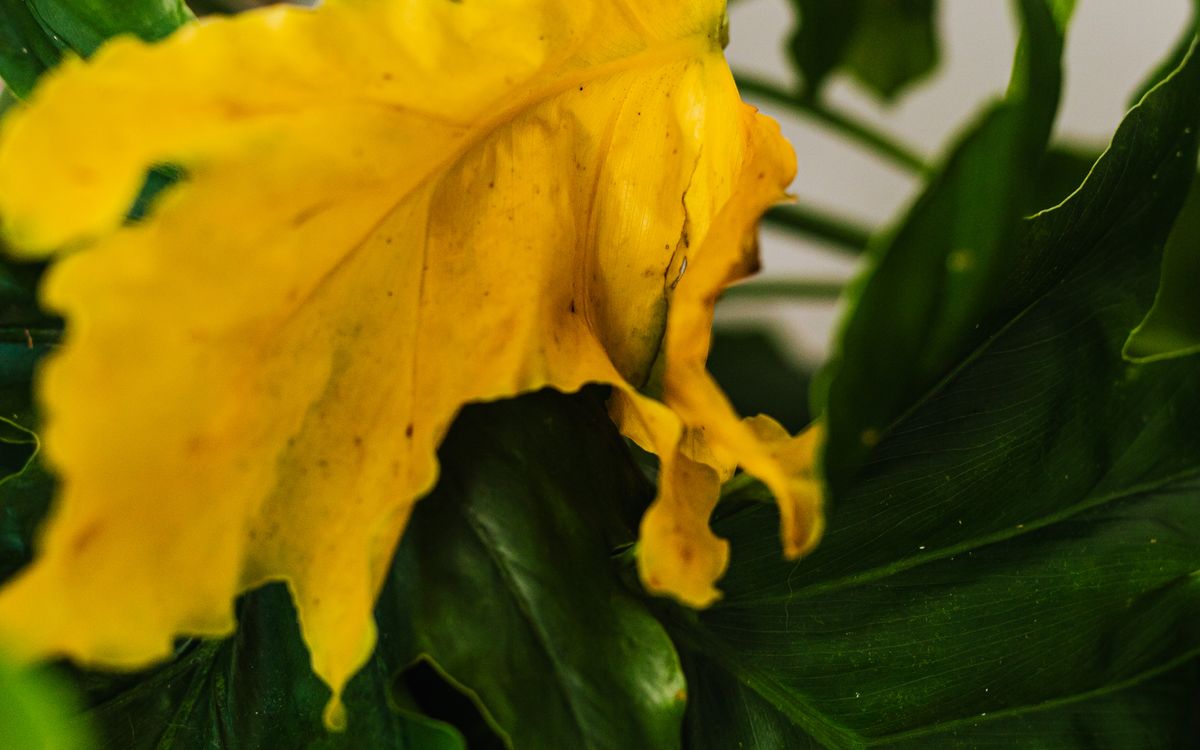
The short version
- A bottom leaf or two, slowly, while the rest looks fine is usually a plant doing housekeeping.
- Older leaves, evenly pale and spreading upward points at nitrogen.
- New leaves yellow with green veins still showing points at iron or manganese, often a soil pH problem rather than a shortage.
- A lot of leaves at once, including new ones is not a feeding problem. Check the roots and the watering.
- Yellow does not turn back to green. Removing the leaf is cosmetic, not treatment.
First question: which leaves went yellow?
Before anything else, look at where on the plant the yellowing sits, and whether it is spreading up or down.
That single observation splits the possibilities more effectively than any amount of staring at the shade of yellow. It works because nutrients differ in whether the plant can move them around once they are in place, and that difference decides which end of the plant shows a shortage first.
Why the position tells you more than the color
Some nutrients are mobile inside the plant. When they run short, the plant strips them out of old tissue and sends them where growth is happening.
Nitrogen is the clearest case. Iowa State University Extension explains the mechanism directly: nitrogen is a mobile nutrient that moves to newer growth when supplies are limited. The visible result is that Older, lower leaves usually turn pale green to yellow first, and if nothing changes, As time progresses, more of the plant will become yellow or chlorotic.
The plant is sacrificing its old leaves to fund the new ones. Yellowing that starts low and creeps upward is that decision made visible.
Iron behaves the opposite way. It does not move once deposited, so a shortage shows up where tissue is being built rather than where it already exists. UC Statewide IPM Program describes the appearance precisely: New broadleaf foliage is undersized and yellow to whitish, except for green along the veins when iron or manganese or both are deficient.
Those green veins against a pale leaf are the most identifiable pattern in this whole subject. If you can see them, you have narrowed the field to two nutrients without touching the plant.
For contrast, the same source gives nitrogen's signature as leaves going evenly pale: Older leaves or needles become uniformly pale green to yellowish when nitrogen is deficient. Uniform versus veined is the second question after old versus new.
Zinc adds a third variation, again on the new growth: Broadleaf foliage becomes uniformly yellowish or pale between the veins, especially on new growth when zinc is deficient.
Reading the pattern
| Where the yellow is | What it looks like | What it points to |
|---|---|---|
| One or two at the bottom | Gradual, rest of plant fine | Normal leaf turnover |
| Older, lower leaves | Evenly pale green to yellow, spreading upward | Nitrogen |
| New growth turning yellow at the top | Yellow to whitish, veins stay green, leaves undersized | Iron or manganese |
| New growth | Pale between the veins | Zinc |
| Many leaves at once, new ones included | Fast, often with other symptoms | Roots and watering, not feeding |
Work down the table in order. The first row is the one people skip, and it is the most common of all.
Browning is a separate reading from yellowing and points at a different set of causes, so if the damage is at the tips and edges rather than across the leaf, start with brown tips on houseplant leaves instead. And if leaves are coming off faster than they are discoloring, the position-based reading below will not converge, because shedding is a general stress response rather than a specific one: work backward through recent changes with houseplant dropping leaves.
When yellow is just a plant being a plant
A yellow leaf is not automatically a problem to solve.
University of Wisconsin Horticulture puts the normal case plainly: plants will occasionally get rid of older, unproductive leaves in favor of new growth, and This is often the case when houseplants drop a yellow leaf or two.
An older leaf lower down, shaded by everything above it, eventually costs the plant more to maintain than it returns. Dropping it is good management.
The threshold for concern is in the same source: When larger amounts of leaves turn yellow, especially including newer growth, other causes need to be investigated. Amount and location together, rather than either alone.
I have lost more plants to overreacting than to under-reacting. A single yellow leaf near the soil, on a plant that is otherwise growing, does not need a diagnosis. It needs to be left alone, or picked off if it bothers you.
Why are my plant leaves turning yellow when it is not nutrients?
Three of the most common reasons for yellow leaves are not deficiencies at all, and feeding a plant that has one of these makes things worse.
Roots that are not working. Wisconsin names it in one line: waterlogged soils may damage roots, which may lead to yellowing of foliage. A plant with damaged roots cannot take up nutrients no matter how much is in the pot, so it produces deficiency symptoms while sitting in plenty. Root damage is the single most likely explanation when a lot of leaves go at once, and it is covered in full in overwatering vs underwatering, including how to tell it apart from the opposite problem.
Soil pH locking nutrients away. The iron in your pot can be present and unavailable. Wisconsin explains why: Iron and manganese are micronutrients which influence green color in leaves, and when the soil pH is out of balance, they become unavailable to the plant and leaves become yellow, or chlorotic. This matters because the instinct on seeing pale new growth is to add iron, when the iron may already be there.
Cold, weeks or months ago. UF Extension warns that invisible chilling injury in peace lilies may be wrongly diagnosed as insufficient fertilization, which is exactly the mistake a deficiency chart invites. If the plant winters near glass and stalls in spring, read houseplant cold damage before adding anything to the pot.
Not enough light. A plant in a dim corner slows down, holds smaller leaves, and sheds lower ones it can no longer justify. That looks like starvation and gets treated with fertilizer, which does nothing for it, because the shortage is light rather than food. If the plant sits well back from the window, run the light estimator before you buy anything, and see what a north-facing window actually gives for what different exposures support, with the other orientations in the light section. When the spot is genuinely below what any tolerant plant will grow in, a lamp is the one fix that works, and grow lights for houseplants covers what the specifications mean. Timing is part of the diagnosis here: yellowing that starts in autumn on a plant that was fine all summer usually tracks the seasonal light drop rather than anything in the pot, which houseplant winter care works through.
Fertilizing a plant that is short of light is the most common well-intentioned mistake in this hobby. It adds salts to soil the plant is not drawing on, which is its own problem.
Should I cut off yellow leaves?
Once a leaf has gone yellow it will not return to green. That tissue is spent.
Removing it is a decision about appearance and hygiene rather than treatment. Take it off if it looks bad, or if it has gone soft and might rot against the stem. Leave it if the plant is otherwise healthy and you would rather not add a wound.
What removal never does is address the reason. If you cut off a yellow leaf and another one follows, nothing has been treated. The pattern is the information, so it is worth noting which leaf went and when before you tidy the evidence away.
Common questions
Why are my plant's bottom leaves turning yellow? Most often normal turnover, especially if it is one or two leaves and the rest of the plant looks well. If it is spreading upward and the yellowing is even rather than veined, nitrogen becomes the likelier answer. If a lot of leaves are going at once, look at the roots instead.
What do yellow leaves with green veins mean? That pattern points to iron or manganese, and UC IPM specifically describes new foliage that is undersized and yellow to whitish with green along the veins. It often reflects soil pH making those nutrients unavailable rather than an actual shortage, so adding more may not help.
Is it normal for houseplants to lose leaves? Yes, in small numbers. Wisconsin Horticulture describes plants discarding older, unproductive leaves in favor of new growth as ordinary behavior. The signal to investigate is larger amounts of yellowing, particularly when new growth is affected too.
Should I fertilize a plant with yellow leaves? Not until you have ruled out roots and light. Both produce deficiency-looking symptoms without any deficiency being present, and fertilizer in either case adds salt to soil the plant is not drawing from.
Will yellow leaves turn green again? No. New growth can come in healthy once the cause is fixed, but an already yellow leaf stays that way. Judge a recovery by what the plant produces next, not by what it already has.
Why are my plant leaves turning yellow: one thing to do differently
Next time you spot a yellow leaf, do not photograph the leaf. Photograph the whole plant.
The useful information is which layer it sits in and what the leaves above and below it are doing, and that is exactly what a close-up crops out. Two photos a week apart, taken from the same spot, will tell you more than any list of ten causes.
One thing that photo also settles, if you inherited the plant or lost the label: which species you are dealing with, since several causes here are species-specific. Identify a houseplant by its leaves works through the common ones by growth form.